From Tipsters to Strategy Building: The Growing Role of Backtesting in Sports Betting
For many people who bet on sports, one key question often comes up: Who should I follow?
For decades, some bettors have relied on tipsters, betting services and advisory platforms to identify potential opportunities in the market. They compare historical records, ROI, profit and, increasingly, metrics such as Closing Line Value (CLV) before deciding whether a particular tipster deserves their attention.
But there is another way to approach the problem. Instead of starting with a tipster, bettors can start with an idea.
What if a particular type of bet performs better within a specific odds range? What if certain competitions behave differently? Does the timing of a bet matter? Can several conditions be combined to create a more robust betting approach?
These questions move sports betting away from simply following predictions and towards researching strategies.
Backtesting itself is nothing new. It has been used for decades in financial markets, quantitative investing and algorithmic trading to test ideas against historical data before putting them into practice. The challenge in sports betting has traditionally been making this type of analysis accessible to individual bettors, particularly when it comes to obtaining reliable, high-quality historical odds data.
This is where Bet2Invest's Strategy Builder comes in.

Through its partnership with Pinnacle and access to Pinnacle's official API, Bet2Invest works with real market odds captured tick by tick, rather than relying on manually entered or simulated prices. This provides access to years of historical betting data that can be used to test strategies against real market conditions.
The new Strategy Builder does not reinvent backtesting. It simplifies it.
Instead of requiring technical skills, complex datasets or custom code, bettors can turn their ideas into structured rules and test them across years of historical data through an accessible interface.
In other words, a process that was traditionally reserved for technically minded users can now be explored much more easily by anyone interested in researching sports betting strategies.
It doesn't promise to predict the future. Instead, it provides a way to investigate the past using real market data and ask better questions about what might work in the future.
From following tipsters to testing ideas
There is nothing inherently wrong with following a professional tipster. A genuinely skilled tipster can spend thousands of hours analysing markets, developing models and identifying opportunities that an individual bettor may not have the time or expertise to find.
The difficulty is determining whether historical performance represents a genuine edge or simply a combination of variance and favourable circumstances. This is one reason why metrics such as ROI alone can be misleading.
A strategy showing +15% ROI over 200 bets may look spectacular. A strategy showing +3% ROI over several thousand bets may initially appear much less exciting. Yet the second dataset may provide considerably more evidence.
This is where a research-based approach becomes valuable. Instead of asking "Which tipster should I follow?", the bettor can ask "What happens when these specific conditions are applied to a large historical sample?"
That is essentially what backtesting allows you to investigate.
What is backtesting in sports betting?
Backtesting consists of applying a set of predefined rules to historical data to determine how those rules would have performed in the past. The concept is familiar in financial markets, where traders and quantitative investors test models against historical prices before considering their use in live markets. The same principle can be applied to sports betting.
A bettor might have a hypothesis such as: certain odds ranges may behave differently, particular sports may contain different market characteristics, some competitions may produce different results, specific pre-match conditions could potentially influence performance…
Instead of relying on intuition, those ideas can be translated into measurable conditions, and the historical data can then provide an answer. Not "Will this strategy win tomorrow?" but "Would these rules have produced interesting results historically?"
That distinction is critical.
Turning a betting idea into rules
One of the biggest advantages of a strategy builder is that it forces an idea to become precise.
Consider the statement: "I think betting underdogs in certain football competitions could be profitable." It sounds interesting, but it isn't yet a strategy.
There are several unanswered questions: which odds? Which competitions? Which markets? Which seasons? Which conditions? How many bets? What was the maximum drawdown? What happened during losing periods?
A strategy builder allows those ideas to be transformed into explicit rules. A bettor could progressively add filters to a strategy and observe how the historical results change. The objective isn't necessarily to find the combination producing the highest possible ROI, in fact, that can be dangerous. The objective is to understand how the strategy behaves.
Bet2Invest's Strategy Builder
This is the thinking behind Bet2Invest's Strategy Builder.
Bet2Invest is a sports betting platform focused on verified performance, historical analysis and the ability to reproduce betting activity using real market data. Its Strategy Builder extends that philosophy from analysing existing strategies to researching new ones.
The tool allows users to create strategies by combining different conditions and filters and then backtest those rules against historical data. The underlying database contains more than 1.5 million historical Pinnacle events, spanning over 10 years of real opening and closing odds (and more soon), across 8 sports: Soccer, American Football, Baseball, Basketball, Tennis, Hockey, Esports and Volleyball.
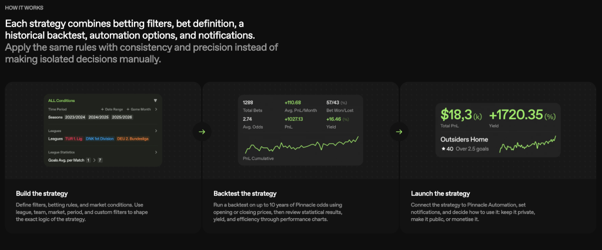
This depth of coverage matters for backtesting specifically. A single season of a single league rarely produces a sample large enough to distinguish genuine effects from noise. Testing a hypothesis across a decade of data and multiple sports gives a much clearer picture of whether an edge holds up, or whether it disappears once market conditions, odds compression or rule changes are accounted for.
The goal is not to tell users which strategy to use. It is to give them the infrastructure to investigate their own ideas, at a scale that manual tracking simply cannot match.
AI can help you start. It cannot invent an edge for you.
Bet2Invest also includes AI assistance within the Strategy Builder. This can be particularly useful when someone has an initial idea but isn't sure how to translate it into structured conditions.
For example, a user might describe an idea in natural language, such as "I want to bet on teams from the top european leagues that are playing home, are favourites (odds between 1.30 and 1.80 (-333 and -125)), and have won at least three consecutive home games" and the AI will propose a starting set of structured conditions, an odds range, a market, a competition filter, etc. ready to be refined and tested in the Builder.
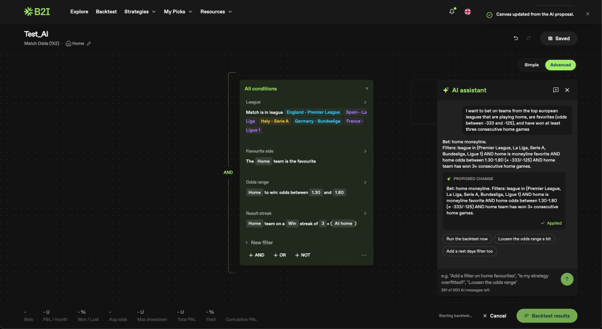
Think of it as a research assistant, rather than a prediction engine. There is an important limitation worth stating plainly: the AI does not discover a guaranteed winning strategy, does not possess a secret formula, and does not create an edge simply because AI was involved. It doesn't eliminate variance or risk. Its role is practical: helping the user move from an initial idea to a testable starting point.
The actual research still belongs to the bettor, who must analyse the results, question the assumptions, test different periods and determine whether the historical performance is robust enough to deserve further investigation.
The danger of overfitting
This distinction becomes particularly important when working with historical data. Backtesting is powerful, but it can also be abused. The biggest danger is overfitting.
Imagine testing hundreds of different combinations of filters. Eventually, some combination will probably produce an impressive historical result simply through statistical coincidence, or because you’ve selected only leagues that appear to be profitable. The more conditions you add, the easier it becomes to create a strategy that perfectly describes the past.
As the standard disclaimer goes: “Past or simulated performance does not guarantee future results.” A strategy that explains the past perfectly may have little predictive value in the future.
This is why the highest historical ROI should never automatically be considered the best strategy. A serious analysis should also examine sample size, ROI, profit, maximum drawdown, consistency, performance across different periods, number of qualifying bets, and stability when conditions are changed.
Bet2Invest automatically adds “caution signals” to alert the user when certain statistics seem too good to be true, or when certain behaviors during strategy creation may indicate that the data has been adjusted to fit past results.
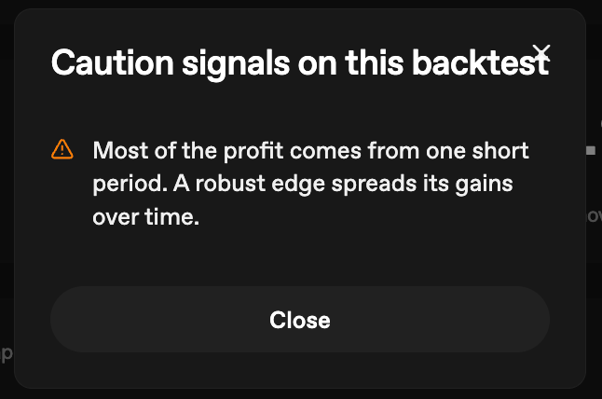
A strategy with slightly lower returns but thousands of observations and relatively stable behaviour may be far more interesting than an extremely profitable strategy based on a tiny sample.
Historical performance is evidence, not a guarantee
This is perhaps the most important principle when using a Strategy Builder. A backtest does not prove that a strategy will work in the future.
Markets evolve. Betting volumes change. Prices adjust. Information becomes more efficiently incorporated into odds. An inefficiency that existed several years ago may no longer exist today. Historical profitability should therefore be viewed as evidence, not certainty.
The purpose of backtesting is to filter ideas. A weak hypothesis can be discarded before capital is put at risk. A more promising one can be investigated further. That alone can be extremely valuable.
Why this approach is different from simply following a tipster
Tipster platforms and strategy builders solve different problems. A tipster provides a ready-made process: the bettor essentially says "I trust this person's analysis enough to follow it."
A strategy builder takes the opposite approach: "I have a hypothesis. Let me test it."
Neither approach necessarily replaces the other, they can complement each other. A bettor might use a strategy builder to investigate a particular market characteristic and then compare those findings with the performance of professional tipsters operating in that market. Likewise, analysing a tipster's historical record can raise questions that lead to new hypotheses.
The ecosystem becomes less about blindly following picks and more about understanding why a betting approach might work.
The role of verified odds
The quality of the underlying data is critical. A backtest is only as useful as the data behind it, and this is another area where Bet2Invest's approach is relevant.
Across its 1.5M+ historical events, the tool uses Pinnacle opening odds to detect opportunities and closing odds to calculate P&L.
Pinnacle is widely regarded as the sharpest and most liquid book in the industry, which is why closing line value against Pinnacle has become a standard proxy for measuring genuine betting skill rather than short-term variance.
Using recorded market prices, rather than reconstructed or estimated historical odds, provides an important distinction. If a strategy is tested against closing prices from a book known for its efficiency, the resulting ROI reflects something closer to what a bettor would actually have faced in the market. Backtests built on unreliable or synthetic pricing data, by contrast, can create a false impression of profitability that evaporates the moment real execution is involved.
Strategy building does not replace bankroll management
A profitable backtest does not tell you how much money you should risk. A strategy can have positive historical ROI while experiencing substantial drawdowns, which is why metrics such as maximum drawdown, variance and sample size remain essential.
Two strategies could both produce a 5% historical ROI while having dramatically different drawdown profiles: one relatively stable, the other prone to long and deep losing periods. The headline ROI is identical. The experience of following the strategies is not.
A strategy should therefore be evaluated as a complete system, not reduced to a single number.
The next generation of sports betting tools
The evolution of sports betting platforms is interesting to trace. The first generation largely focused on finding tipsters. The next generation added better tracking, performance statistics and verification. The emerging generation is increasingly focused on research and strategy development.
Bet2Invest's Strategy Builder fits into this evolution. Its purpose isn't to replace professional tipsters or claim that every bettor can become a profitable quantitative trader overnight. Instead, it provides a framework for asking better questions: take an idea, translate it into rules, test those rules against historical data, analyse the results, and decide whether the hypothesis deserves further investigation.
That is a considerably more disciplined process than trusting an intuition because it sounds convincing.
Final thoughts
The future of sports betting may not simply belong to those who can make the best predictions. It may belong to those who can test their assumptions most effectively.
Tipsters will continue to play an important role, particularly when they can demonstrate transparent, long-term and independently verifiable performance. But bettors now have access to increasingly sophisticated tools that allow them to investigate markets themselves.
The Strategy Builder approach represents an interesting step in that direction. It encourages a process built around:
Hypothesis → Rules → Backtest → Analyse → Challenge → Validate → Execute
AI can make the first step easier by helping transform an initial idea into a structured starting point, but the difficult work remains human. There is no button that creates an edge, no backtest that guarantees future profits, and no AI prompt that turns sports betting into an ATM.
What these tools can provide is something more useful: better questions, better data and a more disciplined way to test ideas. In a market where short-term results can easily be mistaken for skill, that may be one of the most valuable developments of all.
Try it yourself: Bet2Invest's Strategy Builder is available now to test your own hypotheses against over a decade of verified Pinnacle data across 8 sports.
➡️ Explore the Strategy Builder
|